
Bed Bug Treatment
Do you have a bed bug problem?
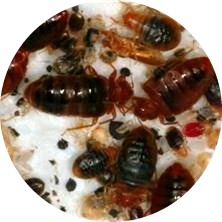
Don’t throw out your mattress! Replacing the mattress will not always rid your home of a bed bug infestation — and a new mattress can just as easily be infested.
It is important to note that insecticides are important for bed bug elimination. We will use different treatment methods to eradicate this pest from your home or business. Application entails treating all cracks and crevices where the bugs are discovered.
Did you know?
Bed bugs are pests of humans and domestic animals, as well as of bats, birds and various other mammals. The food source of bed bugs is the blood of warm-blooded animals.
An adult bed bug is about 1/5 inch long and 1/8 inch wide. Its reddish brown to mahogany-colored body is greatly flattened and oval shaped. After feeding, the bug’s body enlarges considerably, becoming longer and much less flattened. Although the body is covered with tiny hairs, these hairs are so small that they are almost invisible to the naked eye, so the general body appearance is shiny. Bed bugs have piercing/sucking mouth parts that enable them to pierce the skin and suck blood from their hosts.
Are you grossed out yet???
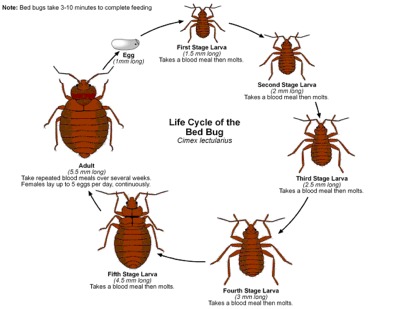
Bed bug eggs are elongated and usually attached to an available surface when laid. Eggs are not known to be placed directly on the host’s body but are typically found on surfaces near where the host sleeps or nests. Each female bed bug lays about 2 eggs per day until she has laid approximately 200. At normal room temperatures these eggs will hatch in 6 to 17 days, producing small almost colorless nymphs that have the general body appearance of the adult.
Bed bugs are hardy insects. Both adults and nymphs can survive prolonged periods without food or under adverse temperature conditions. Adults can live for a year or longer without feeding and can survive over winter in an unheated building. Humans are the preferred host for the common bed bug, but it will feed readily on other animals, such as poultry, mice, rats, canaries, dogs and cats.
Bed bugs generally hide in cracks and crevices during normal daylight hours. They enter such areas easily because of their extremely flattened bodies. Typical hiding places are in the folds and tufts of mattress coils of springs, cracks and hollow posts of bedsteads, and upholstery of chairs and sofas. In heavy infestations, bed bugs are frequently found in unsuspecting places such as: behind loose wallpaper, behind pictures on the wall, under door and window casings, behind baseboards, and even in light fixtures or medicine cabinets!
Bed bugs can be located by looking for the spots of fecal material they often leave in easily visible places. Fecal spots and the bloody spots left on sheets and pillowcases when engorged bugs are crushed serve as sure signs of infestation.
So, How Did You Get Bed Bugs in the First Place?
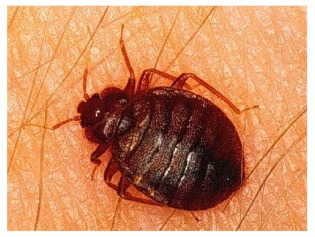
Bed bugs are small, cryptic and agile, escaping detection after crawling into suitcases, boxes, and belongings. The eggs are almost impossible to see when laid on most surfaces. Purchase or rental of secondhand mattresses, box springs, and furniture is another way that the bugs are transported into previously non-infested dwellings.
Once bed bugs are introduced, they often spread room to room throughout a building. Unlike cockroaches that feed on filth, the level of cleanliness has little to do with most bed bug infestations. Pristine homes, hotels, and apartments have plenty of hiding places and an abundance of warm-blooded hosts.